Accreditation and Certification
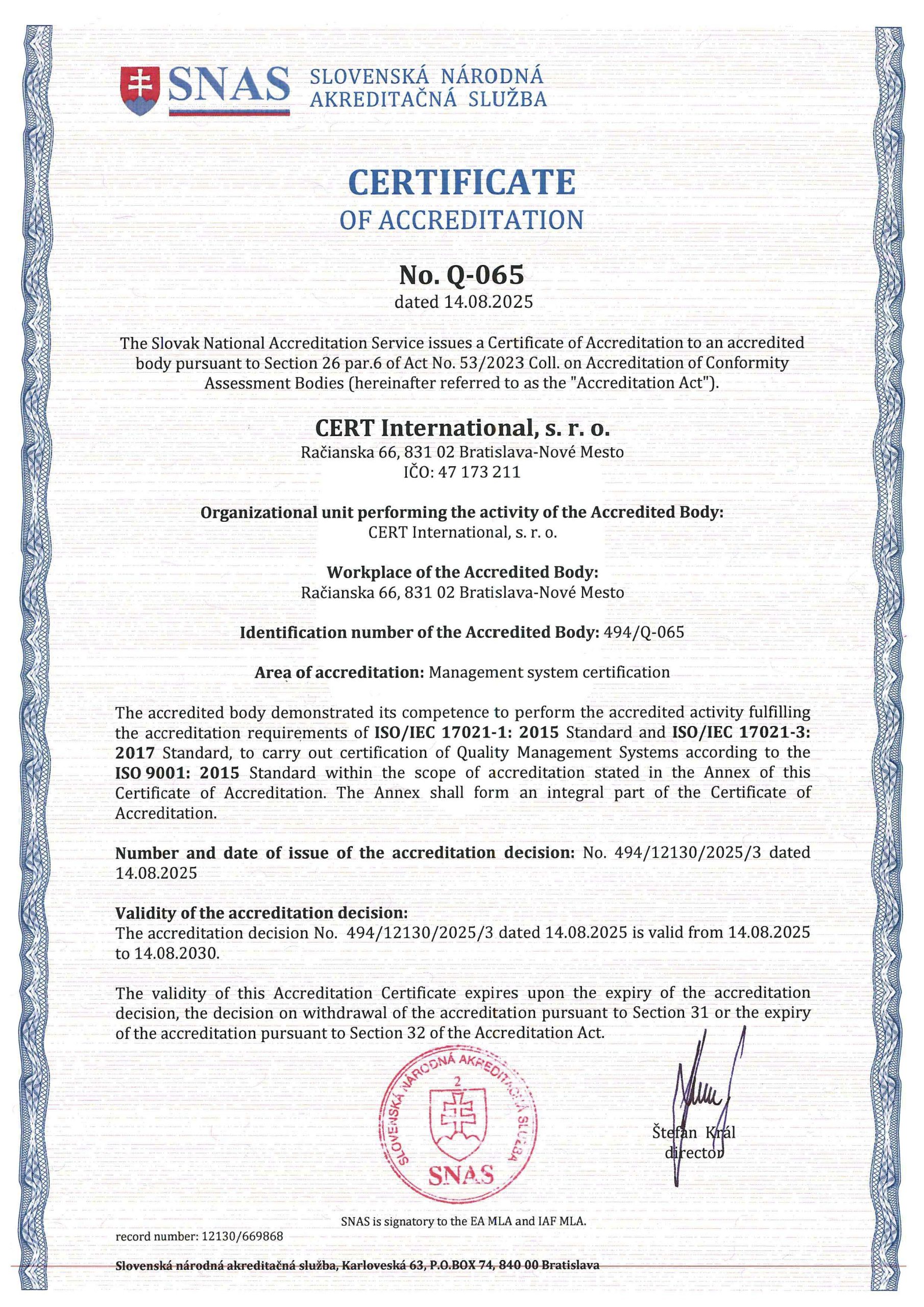
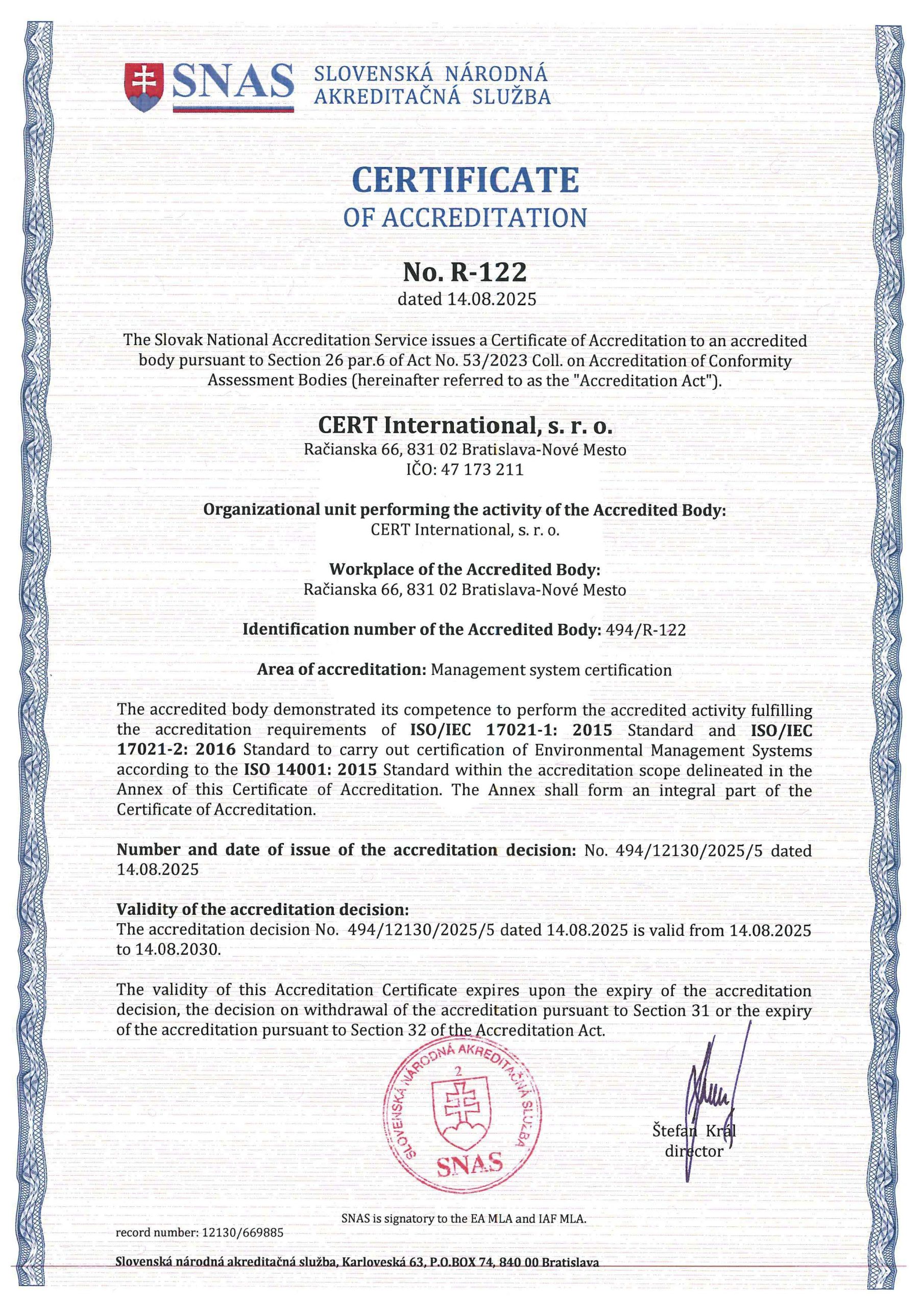
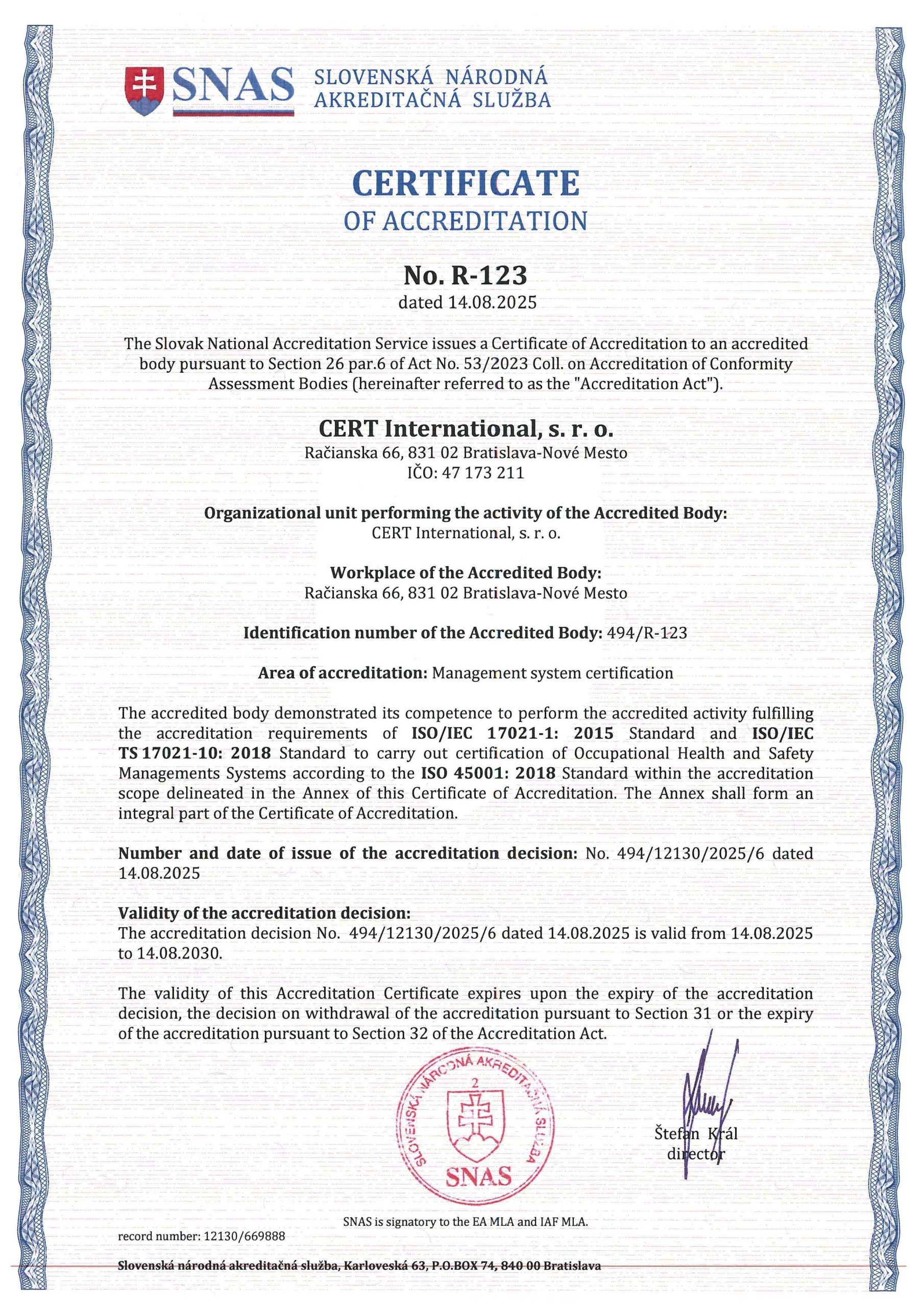
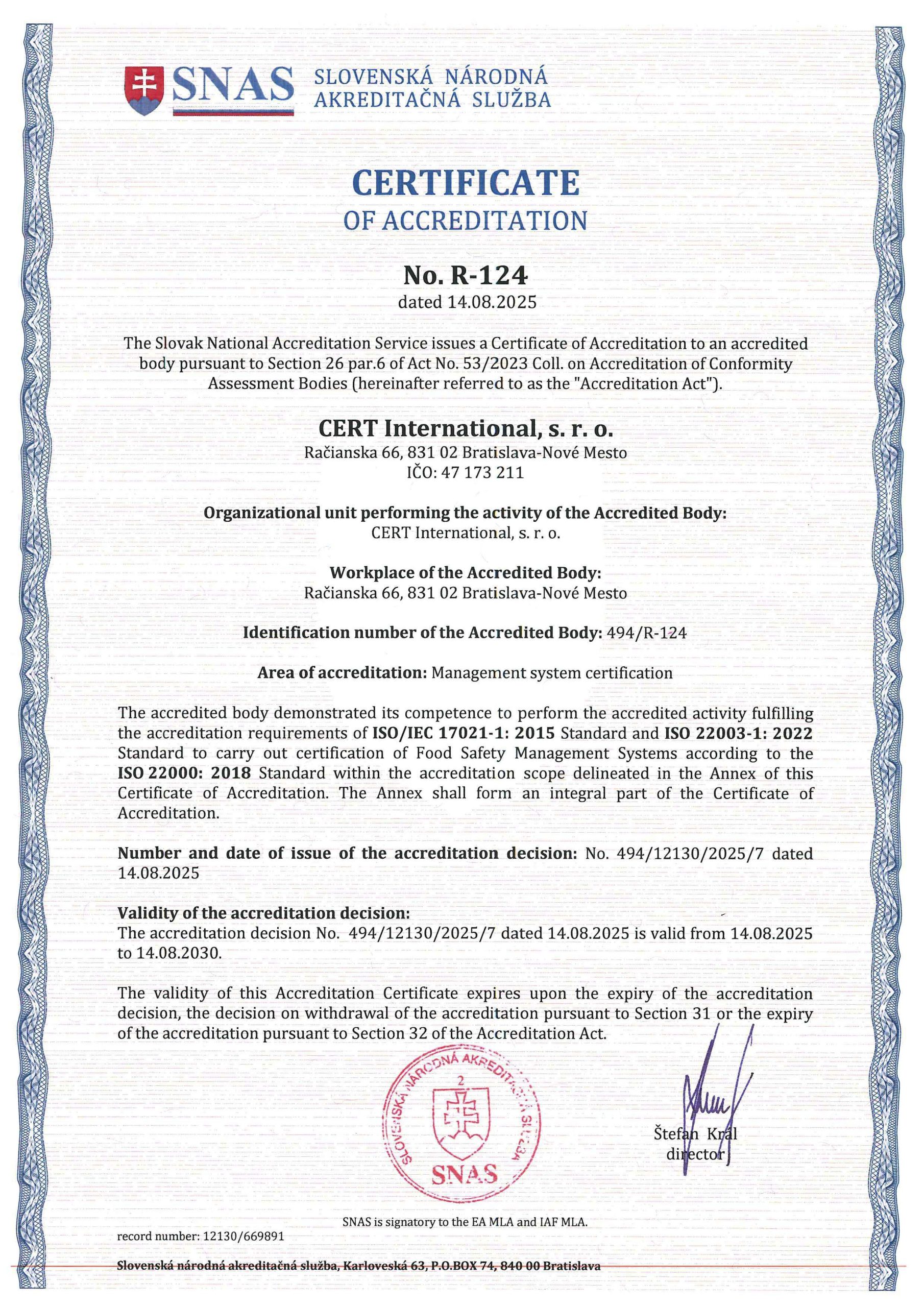
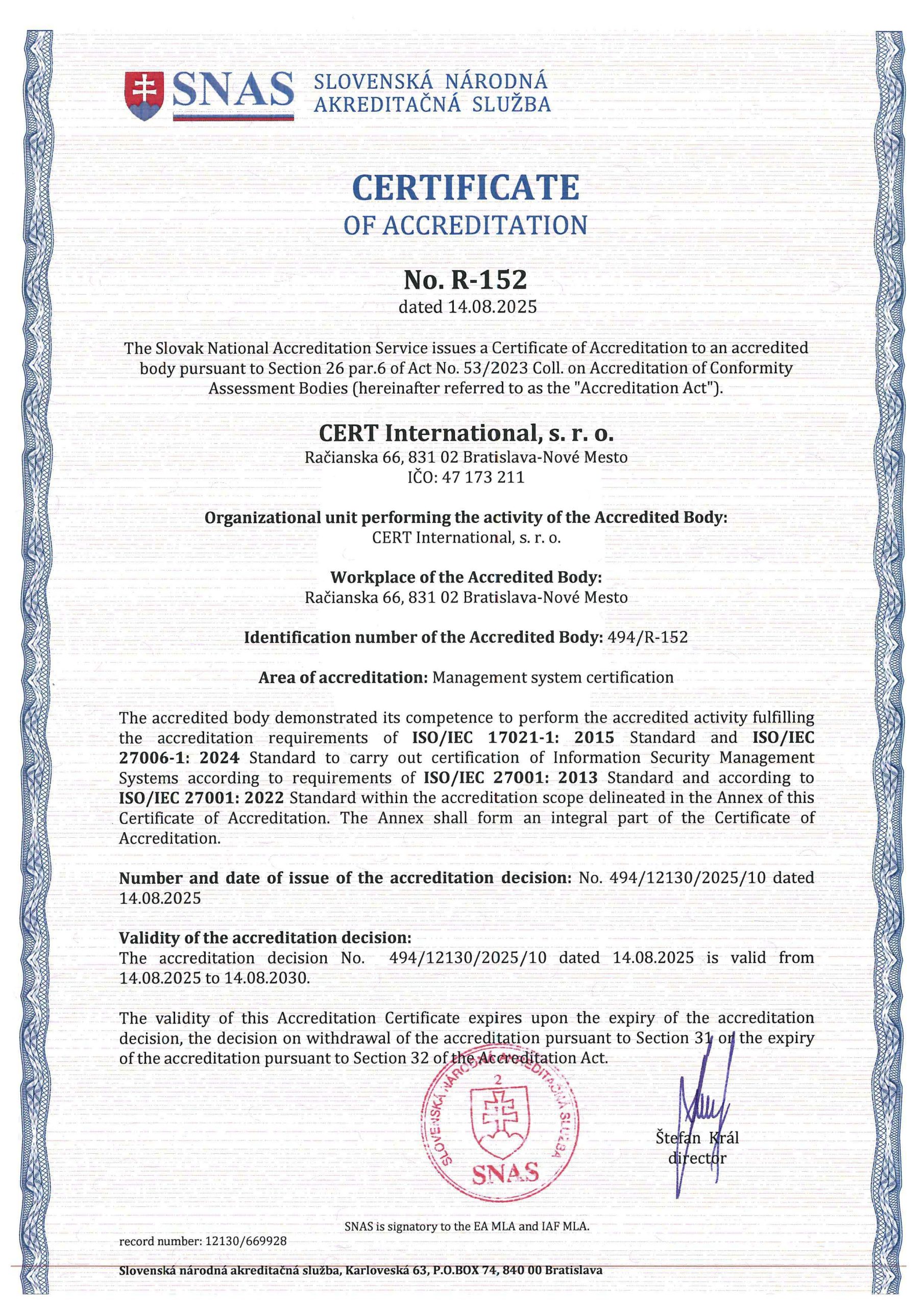
CERT International is accredited in SNAS according to standards: ISO 9001, ISO 14001, ISO 22000, ISO/IEC 27001, ISO 37001, ISO 45001, ISO 50001, ISO 13485.
The SNAS Accreditation Body is a full member of the IAF MLA (Multilateral Recognition Arrangement of the International Accreditation Forum). And provides international recognition of CERT International certificates in more than 100 countries.
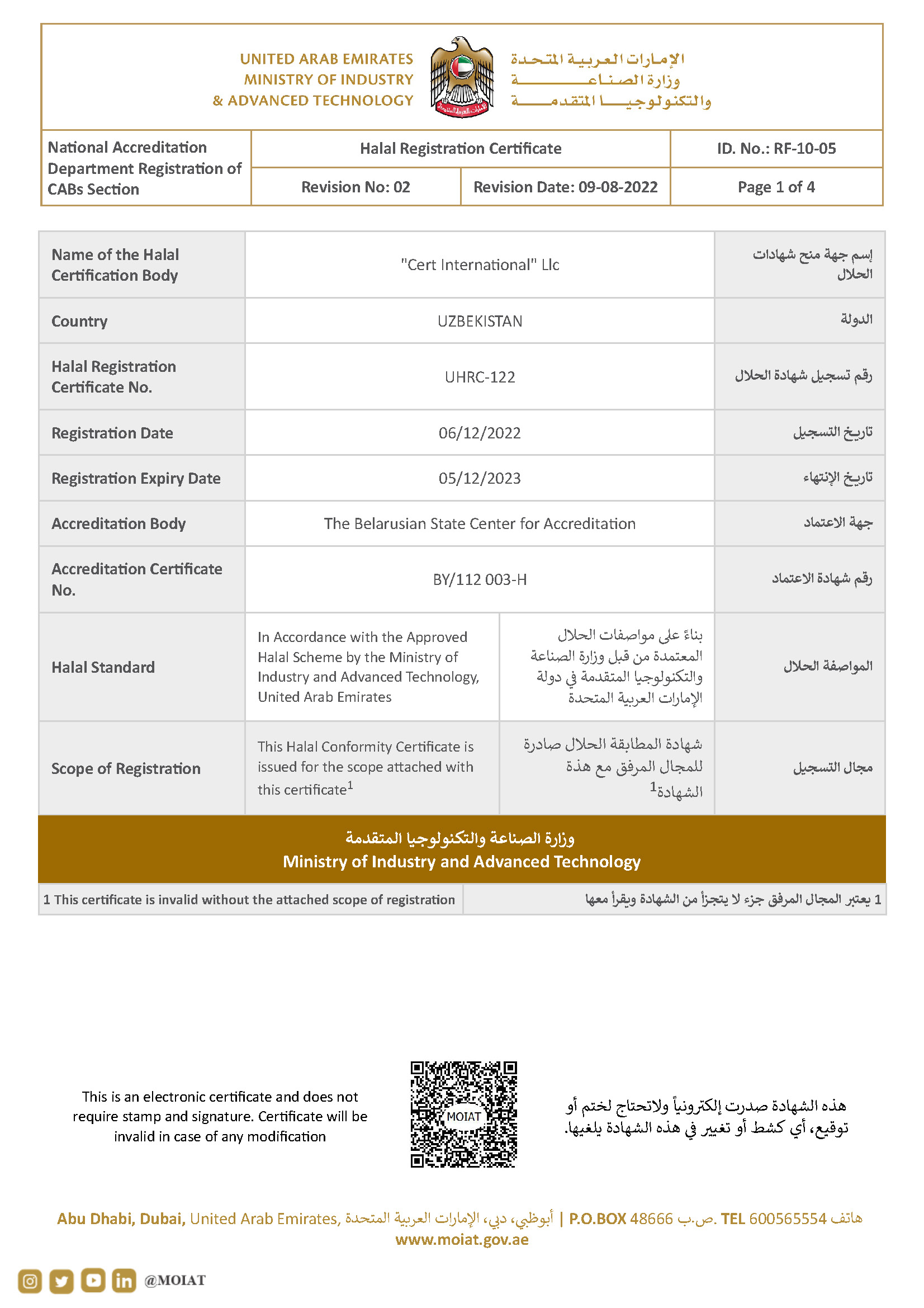
The branch of CERT International in Central Asia, in addition to the above standards, is accredited by U.A.E. (MOIAT / IHAF, International Halal Accreditation Forum) for certification of products according to HALAL standards (GSO).
Documents
The certificates and scope of accreditation can be checked on the website of the Accreditation Body SNAS – www.snas.sk. We will also send this information to you by e-mail if you send a request to info@certin.sk
If you are interested in a quotation for certification services, please fill in the basic questionnaire and send it to info@certin.sk.
With commercial offer we will send you more details and links regarding certification process, as well as the procedure how to deal with complaints and appeals.
If you wish to check the validity of the CERT International certificates issued to any organization, please send a request to info@certin.sk or central@certin.sk.
If you are interested in certification, please read and accept the following certification agreement:
099_VA_Certification_agreement_en (1)
Annexes: 099 VA Appeals and Complaints Procedure (2)
099 АА Description of certification procedure
Impartiality
We understand the importance as part of our mission to ensure the impartiality and transparency of CERT International’s management system certification services.
In accordance with international standards, specific requirements, legislation, we control interests that may affect impartiality and guarantee the objectivity of our management system certification activities.
- PURPOSE OF THE DOCUMENT
1.1. This Anti-Corruption Policy (hereinafter – the “Policy”) is the fundamental document of CERT International Certification Body (hereinafter – the “Company”), which defines the key principles and requirements aimed at preventing corruption and ensuring compliance with applicable anti-corruption laws by the Company, members of its management bodies, employees, and other persons who may act on behalf of the Company.
1.2. The Policy has been developed in accordance with applicable legislation, the Company’s Charter, and other internal documents of the Company.
- OBJECTIVES OF THE POLICY
2.1. The Policy reflects the Company’s and its management’s commitment to high ethical standards of open and honest business conduct, in order to improve corporate culture, follow best practices of corporate governance, and maintain the Company’s business reputation at the appropriate level.
2.2. The Company sets the following objectives:
- to minimize the risk of the Company, its founders, executives, full-time and part-time employees (hereinafter – “Employees”) being involved in corrupt practices;
- to establish a uniform understanding among Employees of the Company’s zero-tolerance approach to corruption in all forms and manifestations;
- to set obligations for Employees to know and comply with the principles and requirements of this Policy, the key provisions of applicable anti-corruption legislation, as well as adequate anti-corruption procedures;
- to summarize and explain the key requirements of anti-corruption laws applicable to the Company and its Employees.
- SCOPE AND RESPONSIBILITIES
3.1. All Employees of the Company must adhere to this Policy and strictly comply with its principles and requirements.
3.2. The Company’s Director is responsible for organizing all activities aimed at implementing the principles and requirements of this Policy, including the appointment of persons responsible for developing, implementing, and monitoring anti-corruption procedures.
3.3. The principles and requirements of this Policy also apply to the Company’s counterparties, representatives, members of governing bodies, employees, and other persons, in cases where such obligations are stipulated in agreements with them, in their internal documents, or directly arise from applicable law.
- APPLICABLE ANTI-CORRUPTION LEGISLATION
4.1. Anti-corruption legislation: The Company and all Employees must comply with the norms of anti-corruption legislation and other regulations, the main requirements of which include the prohibition of giving bribes, receiving bribes, commercial bribery, and mediation in bribery.
4.2. The Company and all Employees must comply with applicable anti-corruption laws, the key requirements of which include:
4.2.1. prohibition of giving bribes, i.e., providing or promising to provide any financial or other benefit/advantage with the intent to induce a person to perform their official duties improperly;
4.2.2. prohibition of receiving bribes, i.e., receiving or agreeing to receive any financial or other benefit/advantage for the improper performance of one’s official duties;
4.2.3. prohibition of bribing foreign public officials, i.e., providing or promising to provide (directly or through third parties) any financial or other benefit/advantage to a foreign public official in order to influence the performance of their official duties to obtain/retain business, or to secure competitive or other advantages for the Company;
4.2.4. prohibition of tolerance of bribery, i.e., failure of a commercial organization to implement adequate procedures aimed at preventing bribery by persons associated with such an organization for the purpose of acquiring or retaining business, or securing commercial and competitive advantages.
4.3. “Corrupt practices” are generally considered to include bribery, mediation in bribery, abuse of office or authority, commercial bribery, facilitation payments, unlawful use of official position for personal gain (money, valuables, property, services, rights for oneself or others), or unlawful provision of benefits or rights to such an official by others.
4.4. All Employees of the Company are strictly prohibited, directly or indirectly, personally or through third parties, from engaging in corrupt activities, offering, giving, promising, requesting, or receiving bribes, or making facilitation payments in any form, including money, valuables, services, or other benefits, to or from any persons or organizations, including commercial entities, government authorities, officials, private companies, and their representatives.
4.5. The Company and its Employees must comply with anti-corruption laws, as well as the principles and requirements of this Policy, in all countries of operation.
- KEY PRINCIPLES
5.1. Mission of senior management
The Company establishes the principle of zero tolerance towards corruption in all forms and manifestations when carrying out its day-to-day operations and strategic projects, including interaction with founders, investors, counterparties, government authorities, political parties, Employees, members of governing bodies, and other stakeholders.
5.2. Periodic risk assessment
The Company identifies and periodically updates indicators of corruption risks inherent to its operations and vulnerable business processes.
5.3. Adequate anti-corruption procedures
The Company develops and implements adequate procedures to prevent corruption, reasonably tailored to the identified risks, and monitors their compliance.
5.4. Counterparty due diligence
The Company makes reasonable efforts to minimize the risk of engaging with counterparties that may be involved in corrupt activities. This includes assessing counterparties’ tolerance for bribery, checking for the existence of their own anti-corruption policies, their readiness to comply with this Policy, including anti-corruption clauses in contracts, and mutual cooperation to promote ethical business conduct and prevent corruption.
5.5. Awareness and training
The Company, where appropriate, publishes this Policy on its corporate website, openly declares its zero-tolerance approach to corruption, encourages compliance by counterparties, Employees, governing body members, and other persons, and promotes anti-corruption awareness through information and training.
5.6. Monitoring and control
The Company monitors the implementation of adequate anti-corruption procedures, oversees compliance, and improves them when necessary.
- GIFTS AND REPRESENTATION EXPENSES
6.1. Gifts and representation expenses, including business hospitality, that Employees may provide on behalf of the Company, or that Employees may receive in connection with their work, must meet the following five criteria:
- be directly related to the Company’s legitimate business purposes (e.g., project presentations, contract execution, conferences, official holidays, anniversaries, birthdays, etc.);
- be reasonable, proportionate, and not luxurious;
- not constitute hidden remuneration for services, actions, omissions, favorable treatment, rights, decisions, agreements, licenses, permits, or attempts to influence the recipient for unlawful or unethical purposes;
- not create reputational risks for the Company or its Employees in case of disclosure;
- not contradict this Policy, business ethics, other Company documents, or applicable laws.
6.2. Gifts in the form of promotional items of modest value with the Company’s branding, provided at exhibitions, presentations, forums, or other official events, are permitted and considered image-building materials.
6.3. Gifts in the form of cash or cash equivalents in any currency are strictly prohibited.
- CHARITABLE ACTIVITIES AND SPONSORSHIP
7.1. The Company does not finance charitable or sponsorship projects for the purpose of obtaining commercial advantages in specific Company projects.
- POLITICAL ACTIVITIES
8.1. The Company does not finance political parties, organizations, or movements for the purpose of obtaining commercial advantages in specific Company projects.
- INTERACTION WITH GOVERNMENT OFFICIALS
9.1. The Company refrains from paying any expenses for government officials or their close relatives (or in their interests) for the purpose of obtaining commercial advantages in specific Company projects, including expenses for transportation, accommodation, meals, entertainment, PR campaigns, etc., or providing them with any other benefits at the Company’s expense.
- INTERACTION WITH EMPLOYEES
10.1. The Company requires its Employees to comply with this Policy and informs them of its key principles, requirements, and sanctions for violations.
10.2. To foster an appropriate level of anti-corruption culture, the Company provides periodic training sessions, both in-person and online, as well as induction training on this Policy and related documents for all new Employees.
10.3. Compliance with this Policy is taken into account when forming the Company’s personnel reserve for promotions, as well as when imposing disciplinary measures.
- PAYMENTS THROUGH INTERMEDIARIES OR TO THIRD PARTIES
11.1. The Company and its Employees are prohibited from engaging intermediaries, partners, agents, joint ventures, or other persons to perform actions that contradict this Policy or applicable anti-corruption laws.
11.2. The Company ensures the existence of procedures for screening intermediaries, partners, agents, joint ventures, and other parties to prevent or detect such violations and minimize risks of the Company being involved in corruption.
- ACCOUNTING RECORDS
12.1. All financial transactions must be accurately, properly, and sufficiently detailed in the Company’s accounting records, documented, and available for verification.
12.2. The Company designates employees personally responsible for preparing and submitting complete and reliable financial reports within the deadlines set by applicable law.
12.3. Misrepresentation or falsification of the Company’s accounting records is strictly prohibited and considered fraud.
- NON-RETALIATION POLICY
13.1. The Company declares that no Employee will be subject to sanctions (including dismissal, demotion, or loss of bonuses) for reporting suspected corruption, or for refusing to give or receive a bribe, engage in commercial bribery, or mediate bribery, even if such refusal results in lost business opportunities or competitive advantages for the Company.
- CONTROL
14.1. The Company conducts regular internal audits of financial and business operations, including verification of accounting records, compliance with applicable legislation, and adherence to internal documents, including this Policy.
14.2. As part of internal control, the Company carries out reviews of key business processes, including selective checks of payment legality, economic justification, and appropriateness of expenses, with confirmation by primary accounting documents and compliance with this Policy.